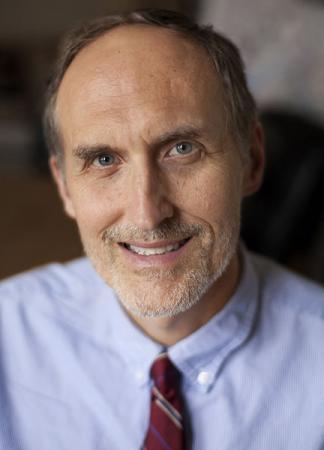
New Brown School of Engineering Dean Larry Larson is profiled by the Providence Business News.
Five Questions With: Larry Larson
 COURTESY BROWN UNIVERSITY "A GREAT UNIVERSITY thrives on the quality of its faculty, and the best faculty member is a rare combination of a brilliant and ambitious researcher and an engaged and passionate teacher," said Larry Larson, The new dean of Brown University’s School of Engineering. |
Lawrence Larson became the inaugural dean of Brown University’s School of Engineering, which was approved to be elevated from a division to a school last year.
Larson, an expert in microelectronics technology and wireless communications, came to Providence from his role as the chair of the Electrical and Computer Engineering Department in the Jacobs School of Engineering at the University of California-San Diego.Last year, Larson predicted that within a decade wireless devices and sensors will be so inexpensive that they could be embedded into almost any manufactured object and located anywhere thought GPS technology in his presentation “Wireless Everywhere and in Everything.”
PBN: First of all, congratulations on your new role. How do you see your first year going? Do you feel ready for the position? Is this a big leap from your previous roles?
LARSON: Thank you! It is great to be here in Providence – after 30 years in southern California, my family and I are looking forward to the beautiful New England fall.
I’m planning to spend a lot of my first year working with everyone at Brown to build momentum for the growth of the School of Engineering. We’re trying to build a world-class research enterprise in Engineering, which builds on our historic strengths in teaching and research, and on our wonderful students.
Becoming a dean is a huge leap for anyone – there are no “dean schools” – but I’m fortunate to have a wonderful staff and amazing faculty here at Brown to help me. So far, the transition has been just great.
PBN: You’ve said that your primary goal is to recruit new faculty in cutting-edge research areas. Who’s on your dream list?
LARSON: A great university thrives on the quality of its faculty, and the best faculty member is a rare combination of a brilliant and ambitious researcher and an engaged and passionate teacher. My major goal for the next few years will be to find these special people and convince them that Brown is the place they should spend the rest of their careers. We’ll be recruiting in areas of Engineering that have special interdisciplinary connections to the rest of Brown, and are in emerging areas of key societal needs: health care, the environment, energy and entrepreneurship.
PBN: You’ve also mentioned that you’d like to expand on graduate programs and create “groundbreaking” undergraduate programs. What did you have in mind?
LARSON: Most engineers go on to do graduate work at some point in their careers – it’s almost a requirement if you want to do cutting-edge work. One of our goals in the coming years is to expand our offerings of master’s degree programs that are targeted at students who want to take this next step in their careers. At the same time we also intend to expand our Ph.D.-level research, which is a key means for creating the new knowledge and new technologies that create new jobs and benefits all of society.
Life-changing undergraduate education is the heart of Brown University. One of the things I want to expand in the coming years is undergraduate research opportunities. Brown’s undergraduates are just amazing, and I want to make sure that each of them has the opportunity to work in a professor’s lab and have a meaningful research experience.
PBN: How do you plan to lead Brown’s school through the “fundamental transformation” that engineering is undergoing as barriers between traditional disciplines meld? What’s the strategy?
LARSON: One of the reasons I was attracted to Brown is its unique collaborative and interdisciplinary culture. This culture is uniquely well suited to the changes that are going on in the world around us, where traditional barriers between disciplines are breaking down, and great new opportunities lie at the boundaries between disciplines. So, we will look for new faculty members who are well suited to thrive in this new world in which we find ourselves. We already have some great examples of faculty here in Engineering who are leading the way. For example, Professor Arto Nurmikko’s work with John Donoghue and the Warren Alpert Medical School on brain interface technologies unites the disciplines of neuroscience, engineering, biology and medicine.
PBN: Where’s the current weak spot at the school that you’d like to fix?
LARSON: I’ve been amazed by the broad strengths of the Brown program since I arrived. The engineering program at Brown is the oldest in the Ivy League and the third oldest civilian engineering program in the U.S. So, we have a rich and distinguished history. We’re really focused on making it even better and more visible, by recruiting the best faculty, expanding our educational offerings, and building a modern and expanded space for our ground-breaking research.
Larson, an expert in microelectronics technology and wireless communications, came to Providence from his role as the chair of the Electrical and Computer Engineering Department in the Jacobs School of Engineering at the University of California-San Diego.Last year, Larson predicted that within a decade wireless devices and sensors will be so inexpensive that they could be embedded into almost any manufactured object and located anywhere thought GPS technology in his presentation “Wireless Everywhere and in Everything.”
PBN: First of all, congratulations on your new role. How do you see your first year going? Do you feel ready for the position? Is this a big leap from your previous roles?
LARSON: Thank you! It is great to be here in Providence – after 30 years in southern California, my family and I are looking forward to the beautiful New England fall.
I’m planning to spend a lot of my first year working with everyone at Brown to build momentum for the growth of the School of Engineering. We’re trying to build a world-class research enterprise in Engineering, which builds on our historic strengths in teaching and research, and on our wonderful students.
Becoming a dean is a huge leap for anyone – there are no “dean schools” – but I’m fortunate to have a wonderful staff and amazing faculty here at Brown to help me. So far, the transition has been just great.
PBN: You’ve said that your primary goal is to recruit new faculty in cutting-edge research areas. Who’s on your dream list?
LARSON: A great university thrives on the quality of its faculty, and the best faculty member is a rare combination of a brilliant and ambitious researcher and an engaged and passionate teacher. My major goal for the next few years will be to find these special people and convince them that Brown is the place they should spend the rest of their careers. We’ll be recruiting in areas of Engineering that have special interdisciplinary connections to the rest of Brown, and are in emerging areas of key societal needs: health care, the environment, energy and entrepreneurship.
PBN: You’ve also mentioned that you’d like to expand on graduate programs and create “groundbreaking” undergraduate programs. What did you have in mind?
LARSON: Most engineers go on to do graduate work at some point in their careers – it’s almost a requirement if you want to do cutting-edge work. One of our goals in the coming years is to expand our offerings of master’s degree programs that are targeted at students who want to take this next step in their careers. At the same time we also intend to expand our Ph.D.-level research, which is a key means for creating the new knowledge and new technologies that create new jobs and benefits all of society.
Life-changing undergraduate education is the heart of Brown University. One of the things I want to expand in the coming years is undergraduate research opportunities. Brown’s undergraduates are just amazing, and I want to make sure that each of them has the opportunity to work in a professor’s lab and have a meaningful research experience.
PBN: How do you plan to lead Brown’s school through the “fundamental transformation” that engineering is undergoing as barriers between traditional disciplines meld? What’s the strategy?
LARSON: One of the reasons I was attracted to Brown is its unique collaborative and interdisciplinary culture. This culture is uniquely well suited to the changes that are going on in the world around us, where traditional barriers between disciplines are breaking down, and great new opportunities lie at the boundaries between disciplines. So, we will look for new faculty members who are well suited to thrive in this new world in which we find ourselves. We already have some great examples of faculty here in Engineering who are leading the way. For example, Professor Arto Nurmikko’s work with John Donoghue and the Warren Alpert Medical School on brain interface technologies unites the disciplines of neuroscience, engineering, biology and medicine.
PBN: Where’s the current weak spot at the school that you’d like to fix?
LARSON: I’ve been amazed by the broad strengths of the Brown program since I arrived. The engineering program at Brown is the oldest in the Ivy League and the third oldest civilian engineering program in the U.S. So, we have a rich and distinguished history. We’re really focused on making it even better and more visible, by recruiting the best faculty, expanding our educational offerings, and building a modern and expanded space for our ground-breaking research.